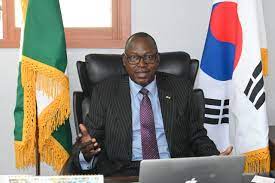
The Nigerian government is responsively taking steps to address climate change, establishing a ministry for environment and advancing cooperation with Korea on climate change, Ali Magashi, Nigerian envoy to Korea, said in an interview with The Korea Herald.
Africa is the “greatest victim” of climate change. Nigeria, Africa’s most populous country, has seen increases in drought and extreme flooding in recent years that has damaged agricultural production — the source of livelihood for many Nigerians.
Ali Magashi said Nigeria, one of the beneficiaries of the UN’s Green Climate Fund, has received $170 million in funding this year to support various climate projects, and is set to another $100 million by the end of the year, according to Magashi.
“Bilateral initiatives with the Nigerian Ministry of Mines and Power that address green energy in Nigeria are underway, there are lot of initiatives existing with Korea and Nigeria stakeholders on addressing climate change issues,” Magashi mentioned.
Nigerian government has pledged to cut greenhouse gas emissions by 20 percent by 2030 compared to “business-as-usual” levels, and up to 45 percent on condition of international aid.
Nigeria has sent a proposal on climate change initiatives to the Korean government that would involve the nonprofit Global Green Growth Institute and cooperation is underway.
Magashi also highlighted Nigeria’s efforts to advance cooperation on science and technology with Korea.
Nigeria has established a Ministry of Communication and Digital Economy and the Nigeria Information Technology Agency, which aims to provide ICT infrastructure for development. He added that the Nigerian embassy is collaborating with Korea Development Institute, a national think tank here, and Korean agencies, for technology exchange in ICT development.
“Nigeria is a huge consumption economy and market (that is) under process to create technology exchange with new investments, transfer of technology and building capacity,”
“Korea-Nigeria Joint Commission would enhance startup cooperation and ratify numerous treaties on trade, tax, defense cooperation, execute treaties to strengthen corporate cooperation and building institutional capacity to further the bilateral relations.”
Magashi said Nigeria, Africa’s largest oil and gas producer, already has strong ties with Korean companies. Daewoo E&C operates a Nigerian bilateral gas project, Samsung and Hyundai Heavy Industries are engaged in making LNG trains for Nigeria and Hyundai Mipo Dockyards are making three LPG vessels.
“There are lots of EPC projects such as bridges, tunnels and LNG trains,” he said EPC refers to engineering, procurement and construction contracts.
Separately, Magashi also expressed his views on the COVID-19 pandemic, saying that the Nigerian government was greatly concerned on how to curb the virus’ spread within its population of over 200 million.
“Before the first case of COVID-19 in Nigeria, the Nigerian government already put the presidential task force to tackle COVID-19 putting all the institutions together, led by the Nigerian Center for Disease Control, and coming from the experience of Ebola not too long before, Nigeria had a very effective disease control infrastructure and the system went into action immediately with responsiveness in controlling COVID-19.”