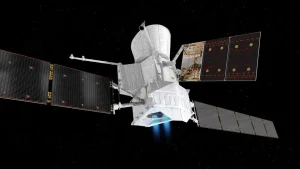
Following a difficult journey, the probe will soon begin unravelling the mysteries of Mercury’s magnetic field and internal structure.
BEPICOLOMBO HAS BEEN on a bit of an Odyssey. The space probe—named after an acclaimed Italian scientist who developed the “gravity assist” trick that enables interplanetary journeys today—was originally scheduled to arrive at Mercury last year. However, after a malfunction with the propulsion, the probe was forced to change course so it could reach Mercury at reduced power. As a result, the arrival date was pushed back by nearly a year, and now after eight years in space, BepiColombo is beginning its descent to low orbit around Mercury.
On September 3, ground control confirmed that the propulsion module had successfully separated from the rest of the craft, marking the final phase of the joint mission between the European Space Agency (ESA) and the Japan Aerospace Exploration Agency (JAXA). After a bumpy journey—reaching more than 200 million kilometers from Earth—transmissions from the probe indicated all went smoothly.
Mercury has only been explored twice before, both times by NASA probes. Because even without propulsion mishaps, Mercury is especially challenging to reach due to it’s position as the closest planet to our sun. When traveling towards the center of our solar system, a spacecraft is essentially “falling” from Earth towards the much greater gravity of the sun. That’s the easy part. The hard part is to not keep falling. Getting to Mercury therefore requires a lot of fuel not to travel there but to engage rockets to put on the breaks.