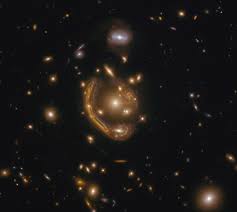
Hubble Space Telescope continues to capture incredible images of the stars despite being in operation for over 30-years. Its latest is of a remote galaxy that has been greatly magnified and distorted by the effects of gravitationally warped space. This molten “Einstein Ring” was measured to be 9.4 billion light-years away, a galaxy at the peak epoch of star formation in cosmic evolution.
It’s unusual partial ring-like appearance is caused by a phenomenon called gravitational lensing, which results in light shining from a faraway galaxy to be warped by the gravity of an object between its source and the observer. Albert Einstein first ehtorized this effect in 1912, and later worked it into his theory of general relativity.
The object, GAL-CLUS-022058s, is located in the southern hemisphere constellation of Fornax (the Furnace). The image was nicknamed the “Molten Ring”, which alludes to its appearance and host constellation.
“This Hubble picture exemplifies the fact that the universe is a vast stage for grand illusions. Albert Einstein realized this a century ago as he formulated his law of general relativity,” Hubble said in a statement.
“This was a time when the universe was going through a ‘baby boom’, forming thousands of stars at a prolific rate. The magnified image of the galaxy gives astronomers a close-up glimpse into the distant past,” Hubble added