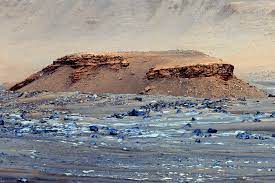
The first scientific analysis of the pictures indicates where the Perseverance rover shows how much water flowed into the crater.
It also reveals evidence that Jezero suffered flash floods.
Now scientists have confirmed the crater was once a lake, and they believe the sediments could contain traces of ancient aqueous life.
Perseverance will look for locations to collect and preserve samples, which will eventually be returned to Earth, where scientists can probe them for signs of Martian life.
“It will take some time to get to the rocks that we really hope to sample for signs of life. So, it’s a marathon, with a lot of potential,” said Tanja Bosak, associate professor of geobiology at MIT.
Satellite pictures had shown the outcrop resembled Earth’s river deltas, where sediment layers are left in the shape of a fan as a river feeds into slower-moving or stagnant water.
Satellite pictures had shown the outcrop resembled Earth’s river deltas, where sediment layers are left in the shape of a fan as a river feeds into slower-moving or stagnant water.
The NASA rover landed in the Jezero crater on 18 February – along with the Ingenuity Mars helicopter – and has been collecting samples and sending back images.
It’s due to spend at least two years exploring the area.
Professor Weiss added: “The most surprising thing that’s come out of these images is the potential opportunity to catch the time when this crater transitioned from an Earth-like habitable environment, to this desolate landscape wasteland we see now.”