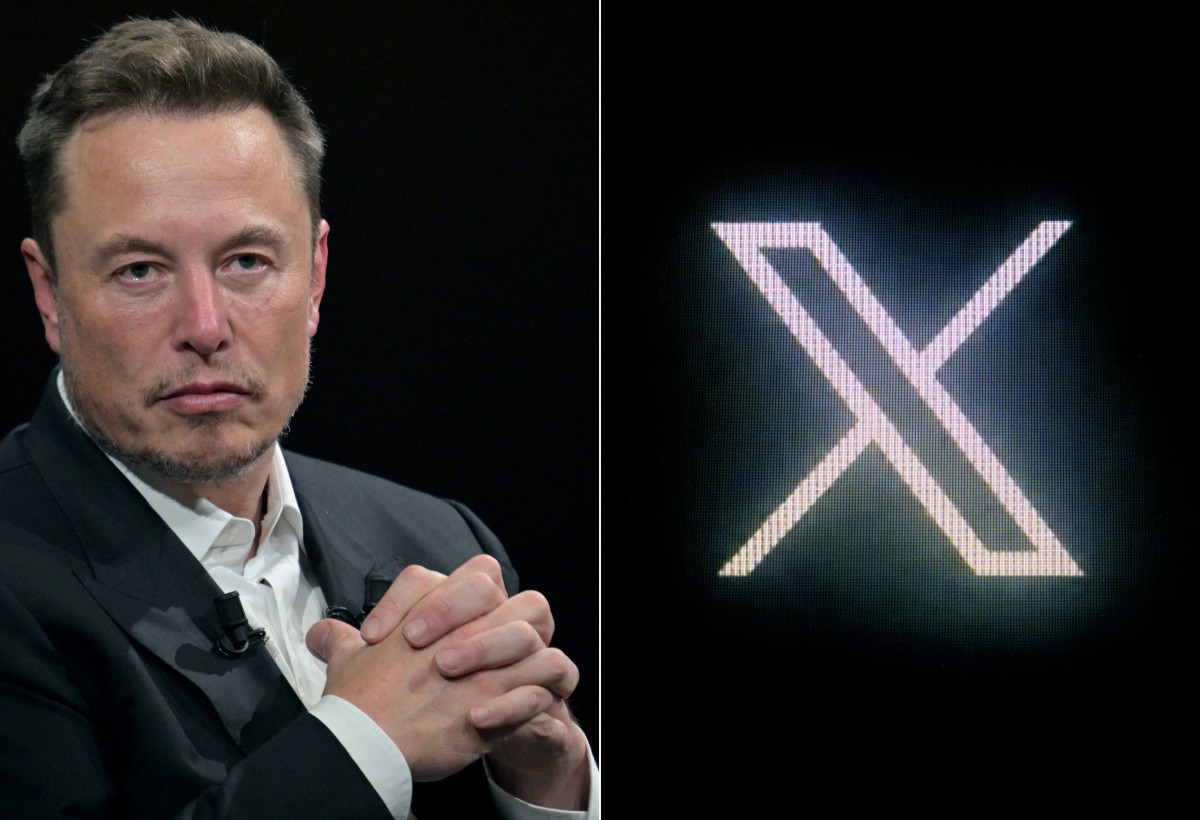
SpaceX, Twitter and electric car maker Tesla CEO Elon Musk during his visit at the Vivatech technology startups and innovation fair at the Porte de Versailles exhibition center in Paris, on June 16, 2023 and (R) the new Twitter logo rebranded as X, pictured on a screen in Paris on July 24, 2023.. The EU’s tech chief on December 5, 2025 denied a US charge it was engaging in “censorship” by fining Elon Musk’s X platform for breaking the bloc’s rules on digital content. (Photo by Alain JOCARD / AFP)
The European Union hit Elon Musk’s X with a 120-million-euro ($140-million) fine Friday for breaking its digital rules, in a move that risks a fresh clash with US President Donald Trump’s administration.
The high-profile probe into the social media platform was seen as a test of the EU’s resolve to police Big Tech — and Vice President JD Vance fired a bullish warning against “attacking” US firms through “censorship” before the penalty was even made public.
Imposing the first-ever fine under its powerful Digital Services Act (DSA) on content, the European Commission said X was guilty of non-compliance with transparency rules including through the “deceptive design” of its blue checkmark for “verified” accounts.
“This decision is about the transparency of X” and “nothing to do with censorship,” the bloc’s tech chief Henna Virkkunen told reporters as it was announced — pushing back at Vance’s charge.
The US vice president warned the EU pre-emptively Thursday it “should be supporting free speech not attacking American companies over garbage” — in an X post to which Musk replied “Much appreciated.”
Musk’s platform was targeted by the EU’s first ever formal DSA investigation in December 2023 — and preliminarily found to have breached its rules on several counts in July 2024.
The EU found that changes made to the platform’s checkmark system after Musk took over in 2022 meant that “anyone can pay” to obtain the badge of authenticity — without X “meaningfully verifying who is behind the account.”
“This deception exposes users to scams, including impersonation frauds, as well as other forms of manipulation by malicious actors,” the commission said in a statement.
It also found X failed to be sufficiently transparent about its advertising and to give researchers access to public data in line with DSA rules.
X remains under investigation over tackling the spread of illegal content and information manipulation — with those parts of the EU probe yet to conclude.