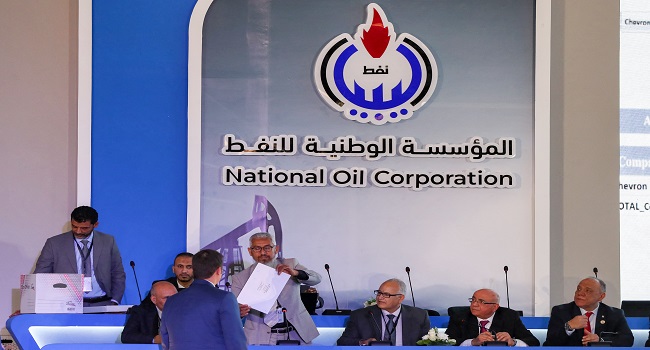
Libya granted several foreign companies new oil exploration and production licences for the first time in 17 years on Wednesday, after more than a decade of political instability.
With oil and gas production and exports at their strongest since 2011, the North African country is seeking to draw major global energy companies back.
But its oil industry has faced significant challenges since a NATO-backed revolt toppled and killed longtime leader Muammar Gaddafi in 2011, with the country still divided between rival authorities.
Wednesday’s winners of the latest bidding round included US oil giant Chevron and Africa’s largest privately-owned energy company, Nigeria’s Aiteo.
The other winning bidders were consortiums: Spain’s Repsol with British Petroleum, Eni North Africa with QatarEnergy, and Repsol with Hungary’s MOLGroup and Turkiye Petrolleri.
But only five blocks drew bids out of a total of 20 offered up for exploration and extraction.
The National Oil Corporation (NOC) announced there will be another bidding round later this year.
“The limited response to the licensing round is underwhelming for the NOC, especially given that dozens of companies — including prominent international oil companies — had pre-qualified,” said Hamish Kinnear, an analyst with UK-based Verisk Maplecroft.
“It is likely that lingering uncertainty over Libya’s political dysfunction and insecurity in the areas around the blocks on offer were factors in the underwhelming response,” he told AFP.
Libya currently produces around 1.5 million barrels a day, sitting on Africa’s largest oil reserves at an estimated 48.4 billion barrels.