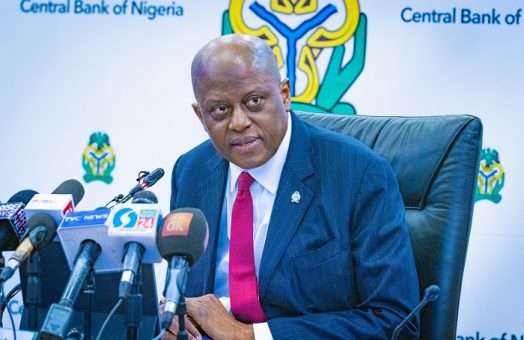
The Governor of the Central Bank of Nigeria (CBN), Mr. Olayemi Cardoso, has disclosed that Nigeria’s external reserves have risen to about $49 billion as of February 5, 2026, describing the development as a clear sign of improving confidence in the country’s economy.
Cardoso spoke on Monday in Abuja at the second edition of the National Economic Council (NEC) Conference, where he explained that the growth in reserves represents a 4.93 per cent increase from the last figure of $46.7 billion which marks a major turnaround from what the country faced when the current CBN leadership took over.
“This is obviously a very important statistic,” Cardoso said. “When we took over, the net reserve figure was about $3 billion. As at the end of last year, the net reserve figure had gone up strongly into the 30s. And as I said, as of February 5, 2026, it is $49 billion. We are now net buyers.”
He explained that the CBN now allows the foreign exchange market to largely determine prices, while the Bank steps in to buy foreign exchange when necessary. According to him, this approach has helped to close the gap between the official and parallel market exchange rates. “The premium between the official and parallel market rates has collapsed to under two per cent,” he said.
Cardoso said remittances from Nigerians living abroad have played a major role in boosting the country’s foreign reserves. He noted that Nigerians in the diaspora come from all parts of the country and are keen to support the economy by sending money home.
“Remittances have made a big difference to how we have grown our reserves,” he said. “The diaspora come from every single state represented here. We have engaged with them and made it easier for them to remit money back to Nigeria.”
He added that the cooperation of state governors and other leaders would be crucial in sustaining this progress in the coming years.
The CBN governor said recent reforms have also made foreign exchange more accessible to ordinary Nigerians, especially those travelling abroad.
“When people travel now, you don’t have to look for foreign exchange to travel,” he said. “You use your naira card and pay for whatever you want. Now the naira is more competitive and people are not afraid to hold naira.”
Cardoso recalled that in the past, the naira was widely rejected in parts of the West African sub-region, but said that situation has changed. “In those days, if you went around West Africa and gave them naira, nobody wanted to touch it,” he said. “That has all gone now. There is predictability and you can plan.”
He warned Nigerians who are holding foreign currency without real need that such actions could lead to losses. “Those holding unnecessary foreign exchange reserves are losing money every day,” he said.
On the banking sector, Cardoso said ongoing recapitalisation efforts are strengthening banks and positioning them to support Nigeria’s long-term economic goals, including the ambition to build a $1 trillion economy.