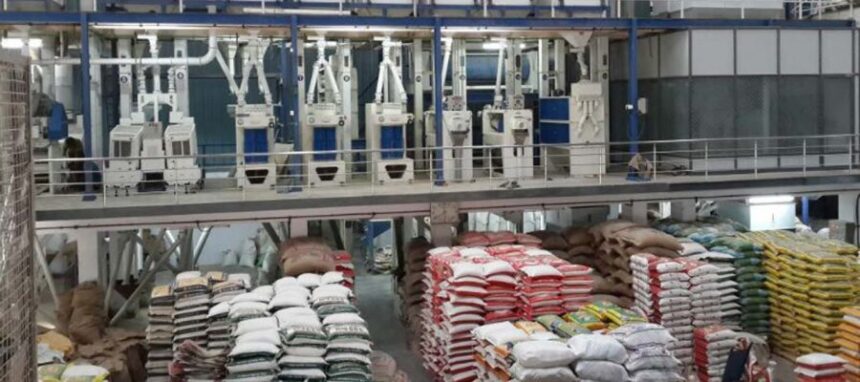
The Central Bank of Nigeria (CBN) has stated that the nation’s rice milling capacity rose to 3,000,000 metric tonnes produced from over 68 integrated mills across the country in January 2022.
According to CBN, the policies of the federal government on agriculture appeared to be working, especially in term of the number of emerging integrated rice mills and the multiplier effects on farmers’ productivity, food availability, job creation and poverty alleviation.
The apex bank also disclosed that over 58 new integrated rice mills have been facilitated to give additional support to the existing 10 mills in the country through various policies of the federal government in the last seven years.
The Governor of the CBN, Mr. Godwin Emefiele, pointed out recently that rice mills in Nigeria were fewer than 10 in 2015, with a combined annual capacity of less than 350,000 metric tonnes.
Emefiele explained that the Anchor Borrowers’ Programme (ABP), which the CBN introduced in 2015, has had catalytic effects on rice cultivation, processing and other value chain activities, adding that about 10 more integrated mills would be opened this year.
He said: “Food security remains a cardinal deliverable for every developing economy as it serves as the fulcrum of many other economic development indices.”
Also, the apex bank has assured rice millers of its collaboration to boost the rice value chain in Nigeria.
The governor called on the operators of integrated millers in the country to invest in the cultivation of rice paddies to complement smallholders’ production and boost availability of raw materials for their mills while driving the policy of the country to be self-sufficient in rice production.
He disclosed this recently in Kano while unveiling the Gerewa Rice Mill, an integrated 420-metric-tonne per day rice mill.
“The private sector-led Accelerated Agriculture Development Scheme provides long-term financing options to millers to finance commercial farms, land development, irrigation facilities; and other agricultural infrastructure that will enhance the production plan,” Emefiele said.
He said the quality of milled Nigerian rice was comparable to that of rice produced elsewhere in the world.
The Head, Farming Initiatives, Olam Nigeria, Mr. Reji George, who led the establishment of Olam’s fully integrated, Africa’s largest mechanised commercial farm and milling facility at Rukubi, in Nasarawa State, said that Nigeria’s production of rice has increased.
George said that availability of sustainable paddies is a great factor to be considered before establishing a rice mill, and indicated that the springing up of more mills was due to available and potential great volume of paddies.
A rice miller and Managing Director, Vertex Rice, Lokoja, Kogi State, Mr. Afis Oladejo, explained to newsmen that the policies of the government on local rice production, processing and consumption, to a great extent, had triggered establishment of new and upgrade of existing rice mills and local rice consumption.
Oladejo called on the armed forces and the police to work harder on internal security of life and property to enhance farmers’ productivity and complements various agro-economic policies of the government.
Also, the Chairman, Bukan Sidi-Lafia Rice Innovation Platform (IP), Nasarawa State who is also the National President, Association of Small-Scale Agro Producers in Nigeria (ASSAPIN), Mr. Joshua Jonathan, said policies, ranging from limited FX for food imports, closure of some land borders to supporting smallholder farmers, had improved rice productivity in terms of quantity, quality and increased consumption of locally produced rice in Nigeria.
He said: “Before now, our scale of production is small – between 1.5 and 2.0 metric tonnes per hectare, but now, Nigerian farmers’ production average yield is between 4.0 -6.0Mt/ha with improved seeds, new production practices, CBN’s anchor borrowers’ support scheme, other initiatives like off-takers’ arrangements, availability of farmer-friendly small-scale improved technologies, especially in pre and post-harvest handling areas have improved greatly the country’s parboiled milled rice.”