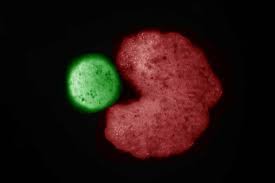
Researchers from the University of Vermont, Tufts University, and the Wyss Institute for Biologically Inspired Engineering at Harvard University have created the first-ever, self-replicating living robots, called Xenobots 3.0.
What is a living robot? They are capable of going out, finding cells, and build copies of themselves repeatedly. They are made from 3,000 embryonic skin cells of an African clawed frog. Read more for a video and additional information.
The Xenobots can essentially swim around while collecting hundreds of single cells to assemble smaller versions of themselves in their mouths, which then grow to be full-sized within a few days. Scientifically speaking, this mode of reproduction is referred to as kinematic replication and common in molecules, but has never been seen in cells or organisms.
Xenobots are sized less than a millimetre, created from the stem cells of the African clawed frog – scientifically known as Xenopus laevis – from where it derives the name. The scientists believe that the new discovery could serve fruitful in the medical field.
Michael Levin, a professor of biology and director of the Allen Discovery Center at Tufts University said “Frogs have a way of reproducing that they normally use but when you… liberate (the cells) from the rest of the embryo and you give them a chance to figure out how to be in a new environment, not only do they figure out a new way to move, but they also figure out apparently a new way to reproduce.”
“These things move around in the dish and make copies of themselves,” Josh Bongard of the University of Vermont, the lead author of the research, told The Guardian.
“These are very small, biodegradable and biocompatible machines, and they’re perfectly happy in freshwater,” he said, adding that near-term applications could include collecting microplastics from waterways.